Dec 10, 2021
What is Down-the-hole drilling?
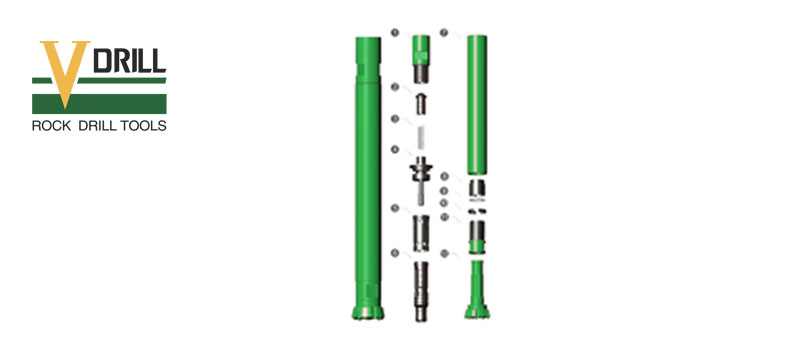
Down-the-hole drilling is to drive the hammer behind the drill bit by compressed air via the drill pipe. The piston strikes the bit directly, while the hammer external cylinder gives straight and stable guidance of the drill bit. This makes the impact of energy is not lost in joints and allows for much deeper percussion drilling.
Furthermore, the impact force acts on the rock at the bottom of the hole, which is more efficient, and straighter than other methods of the drilling operation. And DTH is more suitable for the big hole of hard rock drilling, special for rock hardness over 200Mpa. However, for the rock below 200 MPa, it will not only energy waste, but also in low drilling efficiency, and serious wear to the drill bit. It’s because while the piston of the hammer strike, the soft rock cannot absorb the impact completely, which seriously lower the efficiency of drilling and slagging. The most suitable hole diameter is 100–254 mm, in special applications can be up to 2M And the minimum can be around 50 mm as well.
The range of 3 inches – 34 inches hammers can be used for drilling in mining, quarrying, exploration, water-well, geothermal, and construction/geotechnical projects.
→The most suitable hole diameter is 100–254 mm, in special applications can be up to 2M And the minimum can be around 50 mm as well.
→Theoretically drilling depth is limited by back pressure only (can be up to several kilometers).
→Adapt to hard rock and rock formation conditions (compared to top hammer).
→Mainly use pressurized air for slag flushing, and sometimes air foam for special application.
→Highly efficient in hard rock drilling (compared to rotary drilling).
→Drilling straightness is the best one.
VD drill’s Down The Hole Drilling Tools are manufactured with premium quality steel and use VD’s own carbide inserts techniques that have been developed to suit the toughest applications.